
Recent basement jobs — drag to compare
Basement — Unfinished to Family Space
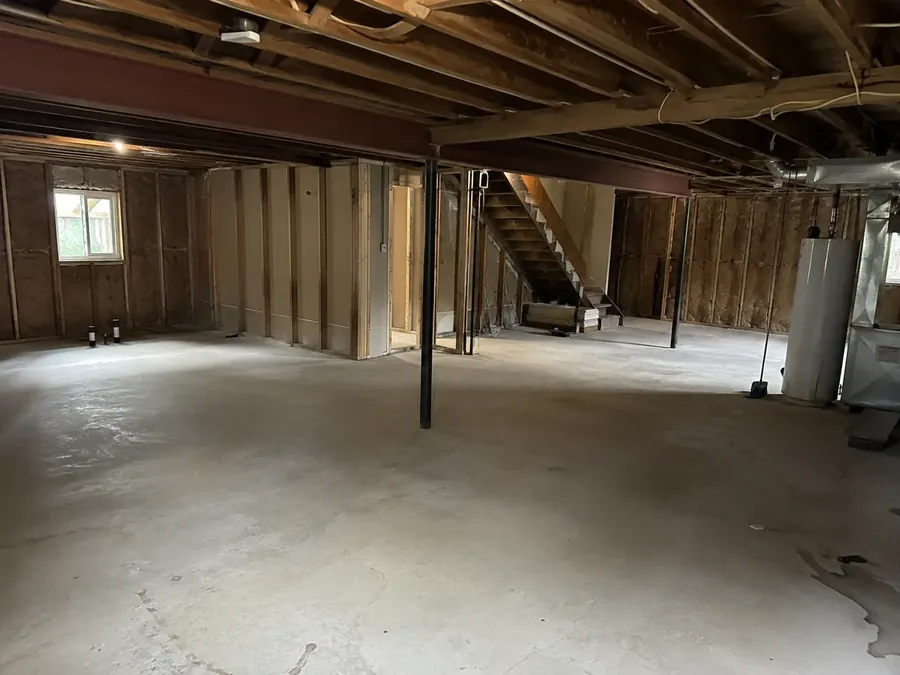
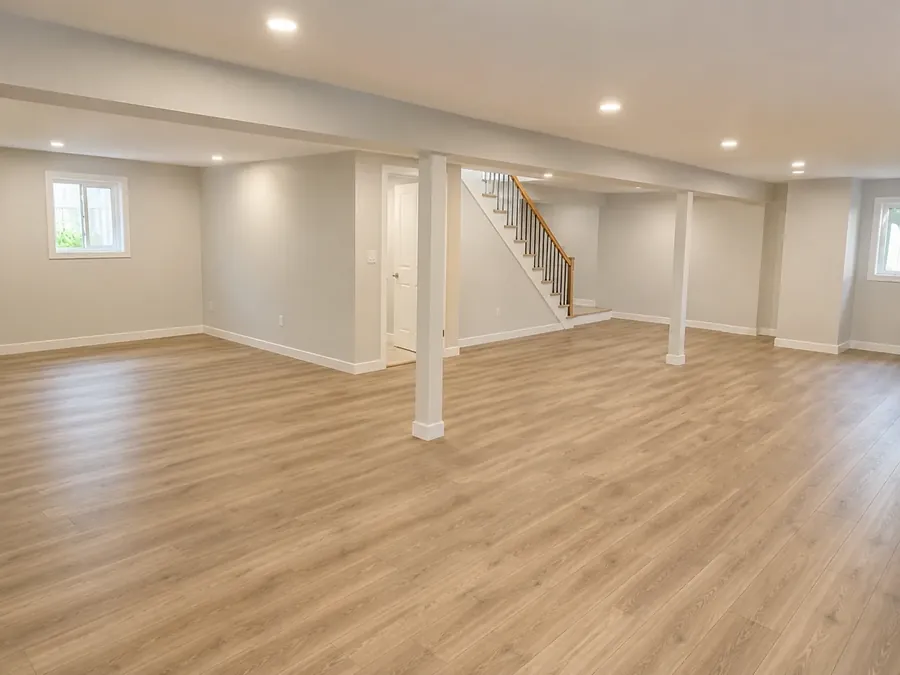 BeforeAfter
Drag the handle — or use the arrow keys — to slide between before and after.
What clients said
"Great work on our basement finish. Ed and his team were on time, on budget, and the finished space looks fantastic. Highly recommend."
"Best contractor experience we've had. Committed to quality — no shortcuts, honest pricing, communication was excellent throughout."
Basement work we handle
- Full basement finishing — framing, insulation, drywall, flooring, trim, paint
- Moisture control before anything else — grading, sump pump, interior drain, vapour barrier
- Egress window installation and window well
- Basement bathrooms, including pump-up systems where the drain sits above the slab
- In-law suites, home offices, gyms, playrooms, media rooms
- Drop ceilings and drywall ceilings with access panels for valves and clean-outs
- Stair rebuilds, railings and wider openings
- Partial finishes — one warm, dry room instead of the whole floor
Water is the whole job in Western Massachusetts
Most of the basements around here are either a poured wall from the 1960s on, or fieldstone and mortar in anything older. Both move water, just differently. Poured walls crack at the corners and at the tie rods. Fieldstone weeps through the joints every spring when the ground thaws and the water table comes up.
Before we talk about flooring or lighting, we look at where the water comes from. Half the time it is outside the house and cheap to fix — downspouts dumping against the foundation, a flower bed graded toward the wall, a window well with no drain. The other half needs a sump pit, an interior perimeter drain, or crack injection. Either way, it gets solved and dries out before the first stud goes up.
Insulation against concrete, done the right way
This is where most do-it-yourself basements go wrong. Fibreglass batts pressed straight against a concrete wall hold moisture against the concrete, and in a year or two you have mould behind the drywall that nobody can see or smell until it is bad.
We put rigid foam against the concrete first, sealed at the seams, then frame in front of it. The foam keeps the warm inside air from meeting the cold wall, which is what makes condensation in the first place. It costs a little more than batts and it is the difference between a basement that stays fresh and one you stop going into.
Ceiling height, egress and the inspector
A finished basement is new living space, so it is inspected like any other room. Two things catch people out. The first is headroom: ducts, beams and old plumbing eat into it, and sometimes a soffit or a re-routed duct buys the inches you need. The second is egress — if any part of it will be a bedroom, it needs a window a person can actually get out of, cut into the foundation with a proper well.
We check both before quoting, not after. If the ceiling is too low to finish legally, you will hear that at the walk-through instead of halfway through the job.
What it costs, honestly
A plain open basement — framing, insulation, drywall, floor, lights, paint — is the low end. A bathroom down there is the single biggest add, because if the sewer line leaves above the slab the toilet needs a pump system. An egress window is a real cost too: it is concrete cutting, not carpentry.
We quote the moisture work separately from the finish work so you can see what you are paying for, and so you can do the dry-out now and the finishing later if that suits the budget better. The written estimate is the price you pay.
FAQ
Do I need a permit to finish a basement?
Yes. A finished basement is new living space, so it needs a building permit, and usually electrical and plumbing permits too. We pull them as part of the job.
My basement gets damp in spring. Can it still be finished?
Often yes, but the water has to be dealt with first — grading, gutters, a sump system or an interior drain. We will not frame over a wall that still gets wet.
How long does a basement take?
A straightforward open basement is usually three to five weeks. Add a bathroom, egress window or structural work and it runs six to eight.
Do I need an egress window?
If any part of the basement is used as a bedroom, yes. For a playroom, office or den it depends on the layout and the local inspector — we check before quoting.
Can you finish just one room?
Yes, and often that is the smart move — one warm dry room now, the rest when you are ready. We frame it so the rest can be added later without tearing anything out.
Where we do this work
Basement finishing across Western Massachusetts and Northern Connecticut — Springfield, West Springfield, Chicopee, and 16 more towns. Same crew, same pricing, same schedule in every one of them.
Often booked alongside drywall and painting and flooring installation. Worth reading first: Is your basement ready to finish?.